
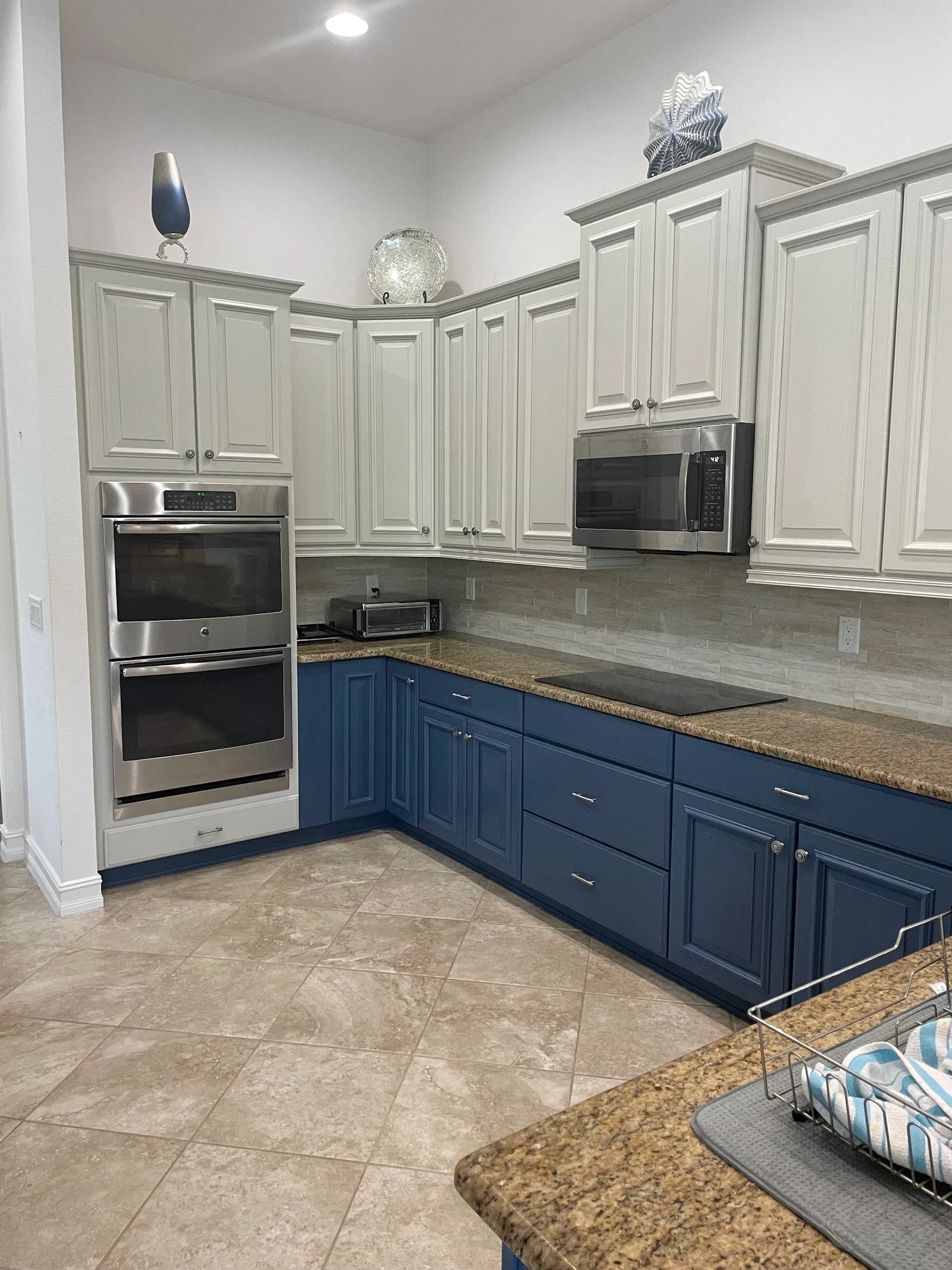
Cabinet Painters in Tampa Bay & Central Florida
Cabinet painting is the highest-return kitchen update available to most homeowners — a finish indistinguishable from new factory cabinetry for roughly a quarter of what replacement costs, and most kitchens start Monday and are back together Friday. Everything below is what separates a finish that lasts from one that looks the same on handoff day and fails in eighteen months.
Enter your ZIP to check availability in your area. Takes 10 seconds — no spam. We are a small local business.
- 362+
- Five-star reviews
- 4.9 ★
- Google rating
- 5 days
- Typical timeline
- Monday start, Friday reinstall
- 2017
- Serving since
What cabinet painting is, and when it is the wrong choice
Cabinet painting refinishes the doors, drawer fronts, and boxes you already own. Nothing is removed from your kitchen permanently and nothing is thrown away. What changes is the color and the finish.
That makes it the right answer for the most common situation by far: sound cabinets in a dated color. It is the wrong answer in three cases, and we will say so rather than take the job:
- The boxes are failing. Water damage under the sink, delaminating carcasses, or shelves that no longer hold weight are structural problems. A finish does not fix structure.
- You want a different door style. Painting keeps your doors. If the profile itself is what you dislike, cabinet refacing replaces the doors and re-skins the boxes to match.
- The layout has to change. Moving a run of cabinets or reworking the island is a remodel, not a finish.
If your cabinets are stained wood and you want to keep the grain visible rather than cover it, cabinet refinishing is the closer fit.
Our process
The most useful way to think about what we do is this: you are sending your cabinets back to the factory to be refinished, and that is the result you should expect.
That is not a figure of speech about quality. Your doors and drawer fronts physically leave your house, get finished in a controlled shop environment with spray equipment and cabinet-grade coatings held to the same standard cabinet manufacturers work to, and come back. The frames stay and are sprayed in place, but the surfaces you touch and look at every day are finished the way they were finished the first time.
That framing is also the honest answer to “why is this more involved than painting a wall.” It is not wall painting. Every step below is included on every job — none of it is an upgrade or an add-on.
Doors off, hardware off. Every door and drawer front is removed and tagged so it returns to the opening it came from. Hinges, knobs, and pulls come off completely. Nothing is painted in place, and nothing is painted around.
Cleaning and degreasing. Professional degreasers are applied and fully rinsed before any abrasive touches the surface. In a kitchen that has been cooked in, this step matters more than any other single thing we do — sanding first only grinds cooking residue deeper into the surface where no primer will bond over it.
Sanding and surface preparation. Sanding creates the mechanical profile the primer grips. Chips, dings, and dents are filled and sanded flush. On open-grain woods like oak and hickory the pores are filled by hand as well — filler is pushed down into them and our own sanding marks taken back off before anything is sprayed, because spray alone bridges the pores and leaves each one as a dark speck under a light color. We fill the pores, not the grain pattern: the character and direction of the wood still reads through the finish. This is the most labor-intensive part of the job and the first thing an underbid removes.
Priming. A bonding primer matched to your specific cabinet material — hardwood, MDF, thermofoil, and melamine each need a different one. Dark cabinets going light need multiple coats to stop tannin bleed-through, which otherwise surfaces weeks later as yellow ghosting in the finish.
Spray application. HVLP or airless equipment, producing an even film with no brush marks and no roller texture — the same method cabinet manufacturers use, and one that cannot be reproduced with a brush no matter who is holding it. Doors and drawer fronts are sprayed off-site in a controlled environment. Frames and boxes are sprayed in place, with the surrounding kitchen masked and contained; expect odor in the house while that stage runs.
Cabinet-grade topcoat. KCMA-certified coatings that cure hard, resist grease and household cleaners, and hold up to Florida heat and humidity.
Reassembly and walkthrough. Doors rehung, hardware reinstalled, alignment and reveals checked, and we walk the finished kitchen with you before we leave.
Questions to ask any cabinet painter
A cabinet finish fails at the bond line — the point where the coating meets the surface underneath — not at the surface you can see. Nearly every failure traces back to a preparation step that was skipped, and preparation is exactly where a cheaper bid finds its margin. It is also invisible on handoff day. Two kitchens can look identical when the crew leaves and be years apart in how long they last.
So ask. These five questions separate the quotes that are cheaper from the quotes that are smaller:
- Do the doors come off, and are they sprayed off-site? Doors painted while hanging cannot be finished evenly, and hardware painted in place is a shortcut you will see every time you open a cabinet.
- What degreaser do you use, and when? Degreasing must happen before sanding. Reversed, it does the opposite of what it is for.
- Which primer, and why that one? The right primer depends on what your cabinets are made of. A crew that uses one primer on everything has not assessed your kitchen.
- Is the topcoat KCMA-certified? That is the factory cabinetry standard. If the answer is a hardware-store paint brand, the finish is not built for a kitchen.
- What does the warranty cover, and who honors it? Ask who you call in year two, and whether they will still be in business when you do.
If a cheaper quote answers these as well as ours does, take it. Most cannot.
What it costs, and why we are rarely the lowest bid
Cabinet painting is priced per door and drawer front, so a kitchen with 32 doors costs roughly twice what a kitchen with 16 does. Most kitchens land between $3,500 and $6,500. Against replacement at $12,000 to $25,000 or more, that is roughly a quarter to a third of the cost to solve the same complaint.
Which is worth sitting with for a second, because it also describes what is at risk. Your cabinets are one of the most expensive fixtures in the house. A finish that fails does not simply look bad — it takes value out of an asset you already own. Stripping a botched job back to a surface that will hold costs more than doing it correctly the first time, and a bad enough one can leave doors and drawer fronts needing replacement to put right — which is the expense you were trying to avoid in the first place.
That is the real arithmetic on a cheap bid. You are not choosing between $3,500 and $2,000. You are deciding whether to risk a fixture worth four times either number in order to save the difference. It is worth doing once, and doing right. Repainting a kitchen you have already paid to have painted is the most expensive outcome on the table.
Our pricing does not move because our schedule is full, and it does not move because of your ZIP code. It reflects the full preparation sequence above, KCMA-certified coatings, and a warranty we honor ourselves. We run the job from start to finish — one company, one relationship, one point of accountability from the first call to the final walkthrough.
Start with your ZIP code and a few short questions about your kitchen, and we will come back with a real number.
Where we offer cabinet painting
- Cabinet Painting in Tampa, FLHillsborough County
- Cabinet Painting in St. Petersburg, FLPinellas County
- Cabinet Painting in Clearwater, FLPinellas County
- Cabinet Painting in Largo, FLPinellas County
- Cabinet Painting in Sarasota, FLSarasota County
- Cabinet Painting in Lakeland, FLPolk County
- Cabinet Painting in Orlando, FLOrange County
What homeowners said
“Premier Cabinet Painting has an exceptional crew. GIOVANI (Jovan) did all the work in my kitchen. You can see the before and after. I am over the moon happy happy happy with the after. Always wanted a white kitchen. And this is absolute perfection. GIOVANI's attention to detail is more than amazing! I would give this company more than five stars if I could. I think the deciding factor was watching the video on their website. That helped sell me. I highly recommend Premier Cabinet Painting and even more, I highly recommend "GIOVANI"!”
“Quality work at a fair price We contacted Premier Painting to refinish our cabinets after seeing their many positive Google reviews—and they were absolutely right. Premier Painting delivered quality work at a fair price. We first spoke with Leah, who explained the process and quickly provided an estimate based on photos and cabinet counts we emailed. Wanting to see colors on actual wood, we visited their shop, where Victor walked us through the process and showed us samples that really helped with our final color selection. After signing the contract, Leah kept us informed every step of the way. Steve and Romin arrived on time each day, protected our condo throughout the project, and did an outstanding job preparing and painting the cabinets, as well as installing the new soft-close hinges. We are completely satisfied with the results and would highly recommend Premier Painting to friends and family.”
“Giovani is excellent!! His attention to detail is above and beyond. Totally worth the money and would 100% use him again! Love my white cabinets!!”
Frequently asked questions
- How much does cabinet painting cost?
- Most kitchens land between $3,500 and $6,500. The number is driven almost entirely by how many doors and drawer fronts you have, because every one of them is removed, tagged, cleaned, sanded, filled, primed, sprayed, cured, and rehung. Full cabinet replacement for the same kitchen typically runs $12,000 to $25,000 or more.
- How long does cabinet painting take?
- Five days for a typical kitchen, three of them with a crew in your home. Most jobs start Monday and are back together by Friday: two days masking and spraying the frames in place, two days finishing the doors and drawer fronts in our shop, and a final day for reinstallation. The on-site frame stage produces odor while it runs. Larger kitchens take a little longer and smaller ones can be quicker, but this is a week — not the multi-week disruption a full replacement becomes.
- Is painting cabinets actually worth it, or should I replace them?
- If the cabinet boxes are structurally sound and only the look is dated, painting returns far more than replacement does — you are paying roughly a quarter of the price to change the thing you actually dislike. Replacement earns its cost when the boxes themselves are failing, when there is water damage in the carcasses, or when the layout has to change.
- What kind of paint do you use?
- KCMA-certified waterborne cabinet coatings — the standard factory cabinet manufacturers are held to. They cure hard, resist grease and household cleaners, and are formulated for Florida heat and humidity. Consumer-grade wall paint is not built for cabinetry and will not survive a working kitchen regardless of who applies it.
- Do I need an in-home estimate before I get a price?
- No. Start with your ZIP code and answer a few short questions about your kitchen, and we come back with a real number — no measuring, no appointment, and no salesperson at your counter. Later in the process we may ask for a short video walkthrough so we can see exactly what we are pricing, but that comes after we have your details, not before. For complex jobs, or once we have agreed on the general number and want to finalize scope, we will come out. That visit is a step in our process, not a condition of hearing a price.
- What if painting is not the right choice for my kitchen?
- Then we will tell you. We assess what you have and say whether painting, refacing, or replacement actually fits it — including when the answer is not the service you contacted us about. We would rather lose a job than sell you something that will not work on your cabinets.
- How do I choose cabinet painters in Tampa Bay?
- Ask what preparation is included before any coating goes on, because that is where a lower bid finds its margin and it is the part you cannot see once the job is done. Ask where the doors are finished and whether frames are sprayed in place. Ask what the warranty covers and who honors it. Cabinet finishes fail at the bond line, and that failure traces back to prep that was skipped — so the answers to those three questions tell you more than the number at the bottom of the quote.
- What does your warranty cover?
- Five years. If the finish chips or peels we touch it up or respray it, and that applies whether the cause was our workmanship or an accident in your kitchen. Most warranties in this trade cover workmanship only and specifically exclude accidental damage, which is the difference worth checking when you compare quotes. You call us directly — the company that did the work is the company that puts it right.
or call (727) 280-5575